
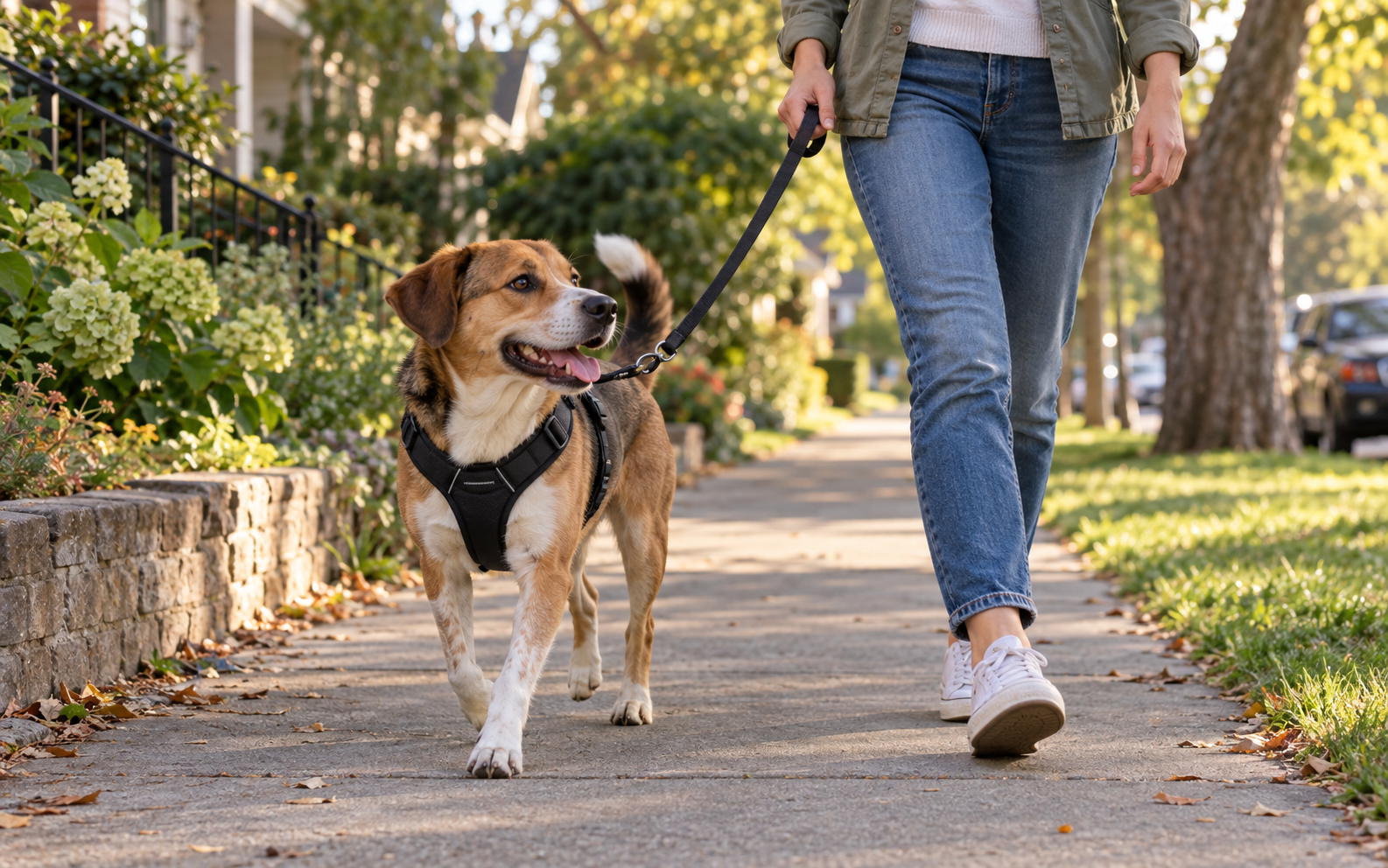
Picture this: a medium dog pulls toward squirrels on neighborhood walks, but the owner wants front-clip steering without a thin strap rubbing behind the legs. That ordinary moment is the useful test. A product succeeds here only when it removes friction without introducing a new maintenance ritual, privacy surprise, or setup problem.
Quick verdict
The Easy Walk Comfort is the PetSafe harness to consider when the classic front-clip idea makes sense but the dog needs more padding, a back attachment for ordinary outings, and a top handle for brief close control. The linked Amazon offer is specifically the black Medium; fit measurements matter more than breed labels or weight alone. This recommendation is about fit, not a numeric score. Product quality can vary by model, firmware, room, and retailer support, so the final choice should be checked against the exact item you are considering.
Dogs that pull on everyday walks and owners who want both front and back leash points, broader padding, and several adjustment points
The dog backs out of harnesses, chews gear when unsupervised, has a shape that falls between sizes, or needs medical mobility support rather than walking guidance
The real-life scenario
In this use case, convenience is only valuable when it survives a normal week: hurried mornings, imperfect Wi-Fi, shared spaces, cleaning, charging, and people who do not want to study a manual. We look for controls that make sense under pressure, maintenance that is easy to remember, and a fallback when the smart feature fails.
The right product should also fit the physical room. Measure clearances, cable paths, door swings, listening distance, storage, and access to power or drainage as relevant. Those details rarely headline a product page, yet they decide whether the purchase feels useful after the first month.
Tradeoffs to accept before buying
- More padding can be warmer and slower to dry than the lighter classic Easy Walk design
- A front attachment helps redirect pulling but does not teach loose-leash behavior by itself
- The linked black Medium is not a universal fit; ordering the wrong variant defeats the recommendation
What to check on the exact product
Confirm this against the exact model, room, and routine before paying.
Confirm this against the exact model, room, and routine before paying.
Confirm this against the exact model, room, and routine before paying.
A low-friction setup plan
- Loosen the straps, identify the chest panel and belly direction, then fit while the dog is standing square
- Use the front clip during controlled training walks and reward slack in the leash rather than relying on equipment pressure
- Recheck strap position after ten minutes of movement and again after washing or coat changes
Keep the first setup deliberately small. Confirm the core job works, learn the reset procedure, and save receipts, serial numbers, recovery codes, and warranty details. Add optional apps or automations only after the basic workflow is dependable.
Who should buy—and who should wait
Buy for this scenario: Dogs that pull on everyday walks and owners who want both front and back leash points, broader padding, and several adjustment points. The product category is a strong fit when the core job happens often enough to justify the storage, charging, cleaning, subscription, or learning cost.
Wait or choose a simpler alternative: The dog backs out of harnesses, chews gear when unsupervised, has a shape that falls between sizes, or needs medical mobility support rather than walking guidance. A lower-tech tool is often the better choice when it is faster, easier to share, and less dependent on an account or app.
Fit is the entire review
A harness can have sensible hardware and still be wrong for a particular rib cage, shoulder angle, or coat. PetSafe asks for shoulder and girth measurements. Take both while the dog is standing, then inspect movement rather than assuming the size label settles the question.
Front-clip steering is a training aid
When the leash attaches at the chest, forward pulling turns the body instead of letting the dog brace straight ahead. That can make a walk manageable, but progress still comes from timing, distance from triggers, rewards, and consistent handling.
The Comfort model earns its name through coverage
Full-body padding and multiple adjustment points spread contact more broadly than a minimal strap harness. The cost is extra material around an active dog. For summer hikes or dogs that dislike coverage, the lighter original Easy Walk may remain the better tool.
Published specifications that change the decision
Alternatives worth comparing
- The original Easy Walk Harness when breathability and minimal coverage matter most
- The Easy Walk 3 in 1 when a dedicated vehicle-restraint loop is part of the routine
- A veterinary rehabilitation harness when the dog needs lifting or mobility assistance
PetSafe Easy Walk Comfort Harness, Black Medium
A padded front-and-back clip harness to compare for a measured medium-size dog that pulls on everyday walks.
Retailer link checked November 17, 2026. This is an affiliate link, so Review Radar Daily may earn a commission from a qualifying purchase at no added cost to you. Price, seller, and availability can change.FAQ
Which Amazon variant is linked?
The article link points to the black Medium Easy Walk Comfort harness, ASIN B0CXTLB6G9. Confirm color and size on the retailer page before checkout.
Can it be used from the back?
Yes. PetSafe lists front and back leash attachment points; the front is intended for no-pull guidance while the back works for regular activity.
Does the handle make it a lifting harness?
No. The top handle offers short, close control. It should not be treated as a medical support or full-body lifting system.
Source and verification note
Primary or authoritative reference checked October 15, 2026: petsafe.com. Product availability, software features, prices, and terms can change; verify the exact model and current retailer information before purchase.