
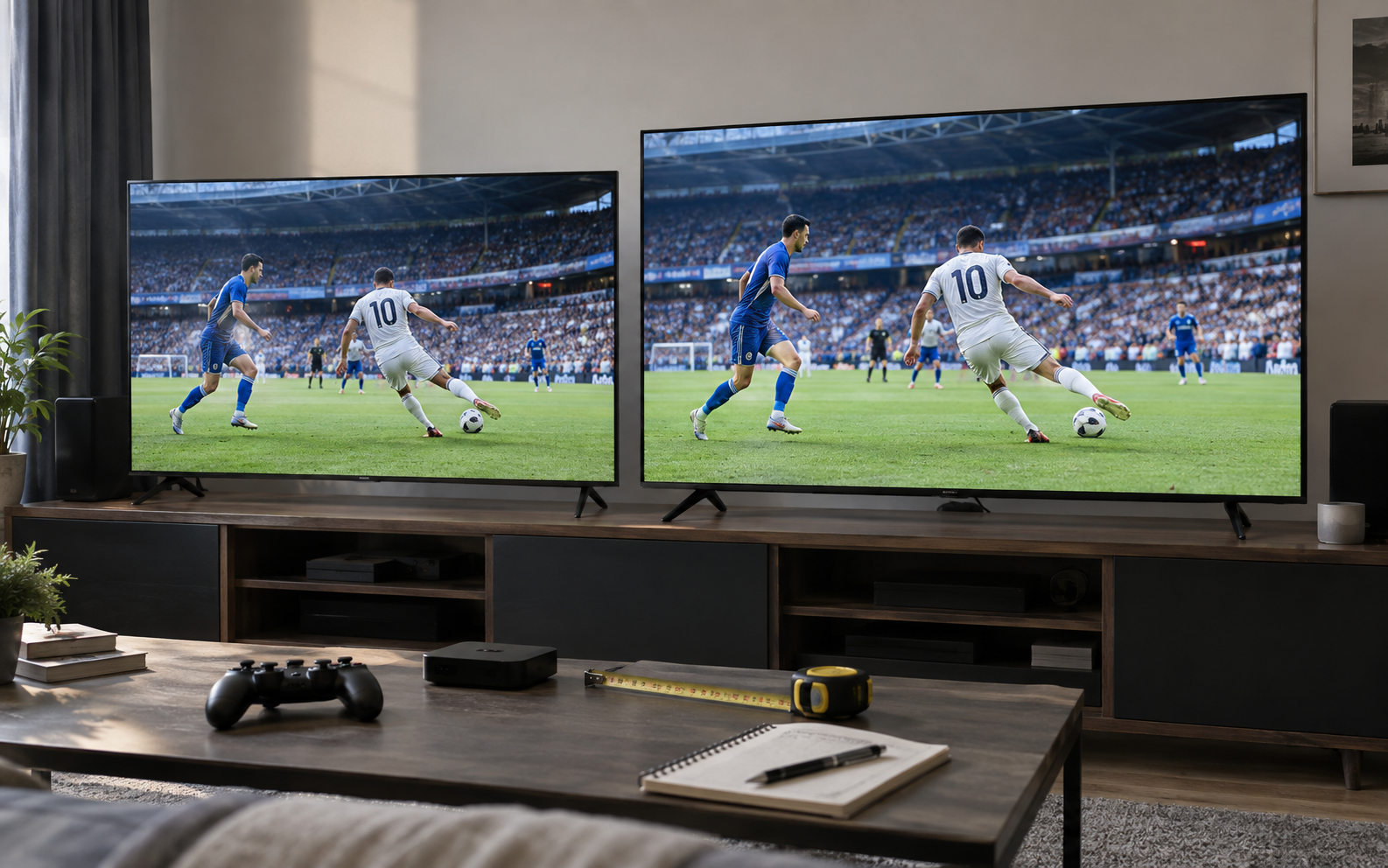
Picture this: two televisions run the same match side by side while a tape measure, console, and notebook force the decision back to room size, glare, and budget. That ordinary moment is the useful test. A product succeeds here only when it removes friction without introducing a new maintenance ritual, privacy surprise, or setup problem.
Quick verdict
Choose the U7SG for the stronger value path to 165 Hz gaming and bright-room MiniLED; choose the U8QG when a genuinely difficult room, larger seating area, and better built-in audio make its higher brightness ceiling useful. The linked models are also different sizes and generations—65U7SG from the 2026 U7 line versus 75U8QG from the 2025 U8 line—so this is a room-and-price decision, not a clean tier-only contest. This recommendation is about fit, not a numeric score. Product quality can vary by model, firmware, room, and retailer support, so the final choice should be checked against the exact item you are considering.
Buyers choosing between the exact linked 65-inch U7SG and 75-inch U8QG for sports, movies, and gaming in a shared room
You have not measured viewing distance and furniture, or current prices make a different size within either series the fairer comparison
The real-life scenario
In this use case, convenience is only valuable when it survives a normal week: hurried mornings, imperfect Wi-Fi, shared spaces, cleaning, charging, and people who do not want to study a manual. We look for controls that make sense under pressure, maintenance that is easy to remember, and a fallback when the smart feature fails.
The right product should also fit the physical room. Measure clearances, cable paths, door swings, listening distance, storage, and access to power or drainage as relevant. Those details rarely headline a product page, yet they decide whether the purchase feels useful after the first month.
Tradeoffs to accept before buying
- The linked models differ by ten inches, so screen size can dominate subtle picture-quality differences
- Both advertise a native 165 Hz panel, but U7 and U8 use different Game Booster claims and source compatibility still matters
- U8's higher brightness and audio ceiling cost more and may duplicate a planned sound system
What to check on the exact product
Confirm this against the exact model, room, and routine before paying.
Confirm this against the exact model, room, and routine before paying.
Confirm this against the exact model, room, and routine before paying.
A low-friction setup plan
- Choose size first using room measurements, then compare picture tier
- Reserve one high-bandwidth HDMI input for the main game source and eARC for audio
- Test both bright and dark content during the return window using restrained picture modes
Keep the first setup deliberately small. Confirm the core job works, learn the reset procedure, and save receipts, serial numbers, recovery codes, and warranty details. Add optional apps or automations only after the basic workflow is dependable.
Who should buy—and who should wait
Buy for this scenario: Buyers choosing between the exact linked 65-inch U7SG and 75-inch U8QG for sports, movies, and gaming in a shared room. The product category is a strong fit when the core job happens often enough to justify the storage, charging, cleaning, subscription, or learning cost.
Wait or choose a simpler alternative: You have not measured viewing distance and furniture, or current prices make a different size within either series the fairer comparison. A lower-tech tool is often the better choice when it is faster, easier to share, and less dependent on an account or app.
The 10-inch difference is not a footnote
At a normal sofa distance, moving from 65 to 75 inches changes immersion more obviously than many menu-level picture refinements. It also changes the delivery route, stand width, wall coverage, and how close the front row can sit comfortably. Tape the outlines on the wall for one evening before comparing specifications.
U8 wins the hard-room argument
Hisense publishes a higher peak-brightness ceiling for U8QG, more elaborate anti-reflection language, and a larger 4.1.2-channel audio system. Those advantages line up with large rooms, daytime matches, and households that want to delay separate audio. They are less decisive after the curtains close and a receiver takes over.
U7 wins when the saved money has a job
The U7SG keeps the native 165 Hz panel, MiniLED architecture, anti-reflection treatment, and gaming focus. If the savings pay for a proper mount, better seating placement, a calibrated setup, or the console you will actually use, the less expensive tier can produce the better room.
Published specifications that change the decision
Alternatives worth comparing
- Compare the same screen size within U7 and U8 when tier difference matters more than scale
- Choose a 120/144 Hz value MiniLED if the main sources never exceed that range
- Choose OLED for a controlled-light movie room and accept its different brightness and ownership tradeoffs
Hisense U7SG or U8QG
A practical comparison of the linked 65-inch U7SG and 75-inch U8QG, starting with room size, glare, gaming sources, and current price.
Retailer link checked September 29, 2026. This is an affiliate link, so Review Radar Daily may earn a commission from a qualifying purchase at no added cost to you. Price, seller, and availability can change.FAQ
Which is better for gaming?
Both linked families advertise a native 165 Hz panel and VRR features. U8 has the higher picture and audio tier, but U7 may be the better value if your room and sources do not use the extra headroom.
Which is better for a bright room?
U8QG has the higher published peak-brightness ceiling and stronger anti-reflection positioning; U7SG still targets bright sports rooms and may be sufficient with better placement.
Why compare a 2026 U7 with a 2025 U8?
Because those are the exact products behind the supplied retailer links. The comparison keeps the model years explicit instead of pretending they are same-year equivalents.
Source and verification note
Primary or authoritative reference checked September 29, 2026: hisense-usa.com, hisense-usa.com. Product availability, software features, prices, and terms can change; verify the exact model and current retailer information before purchase.